The Night
I had just purchased a new f1.4 24mm prime lens from Canon, and I wanted to go out on a dark night to try it out. I had read the reviews on the lens before I purchased it, and tonight was the night to compare the lens to my expectations of it. The skies were clear, and the moon phase was new.
What I saw with the lens was consistent with the reviews I read. There was a bit of vignetting at wide-open apertures, but not quite as much as I expected. On the other hand, there was more barrel distortion than I expected. The images below are with those both corrected with the lens profiles in Adobe Camera Raw.
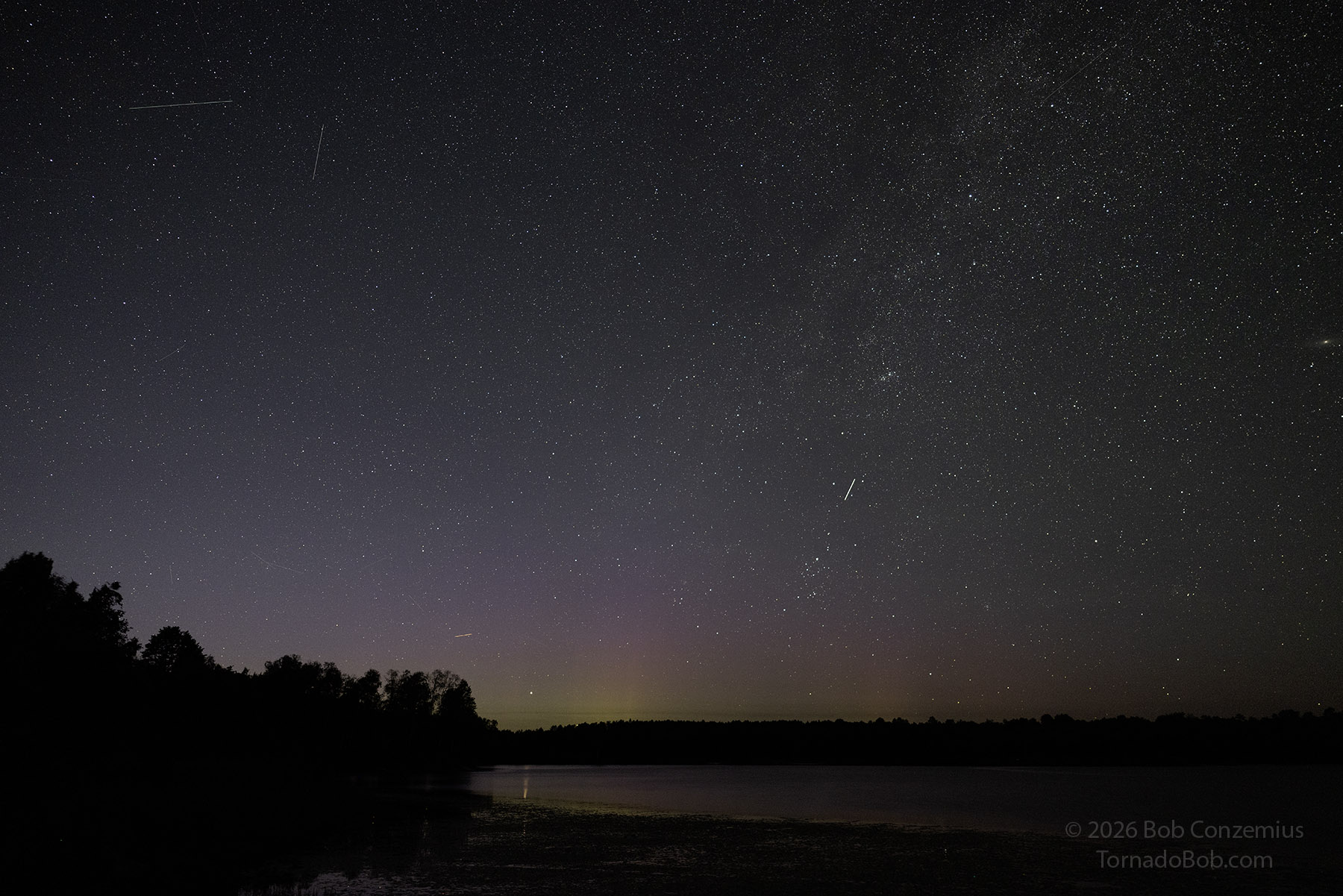
Bz was barely negative, so I really wasn't expecting any auroras, but nonetheless, a faint glow appeared on the horizon. The kP index for the time period 03Z to 06Z, when I was out shooting, was a very low 1.67. This is about the lowest Kp index I've seen auroras in Minnesota. Perhaps there was one other time when the index was 1 (before the scale was fine-tuned to the nearest 1/3), but only the camera got them. This time, I was able to perceive the glow, but it certainly wasn't very bright.
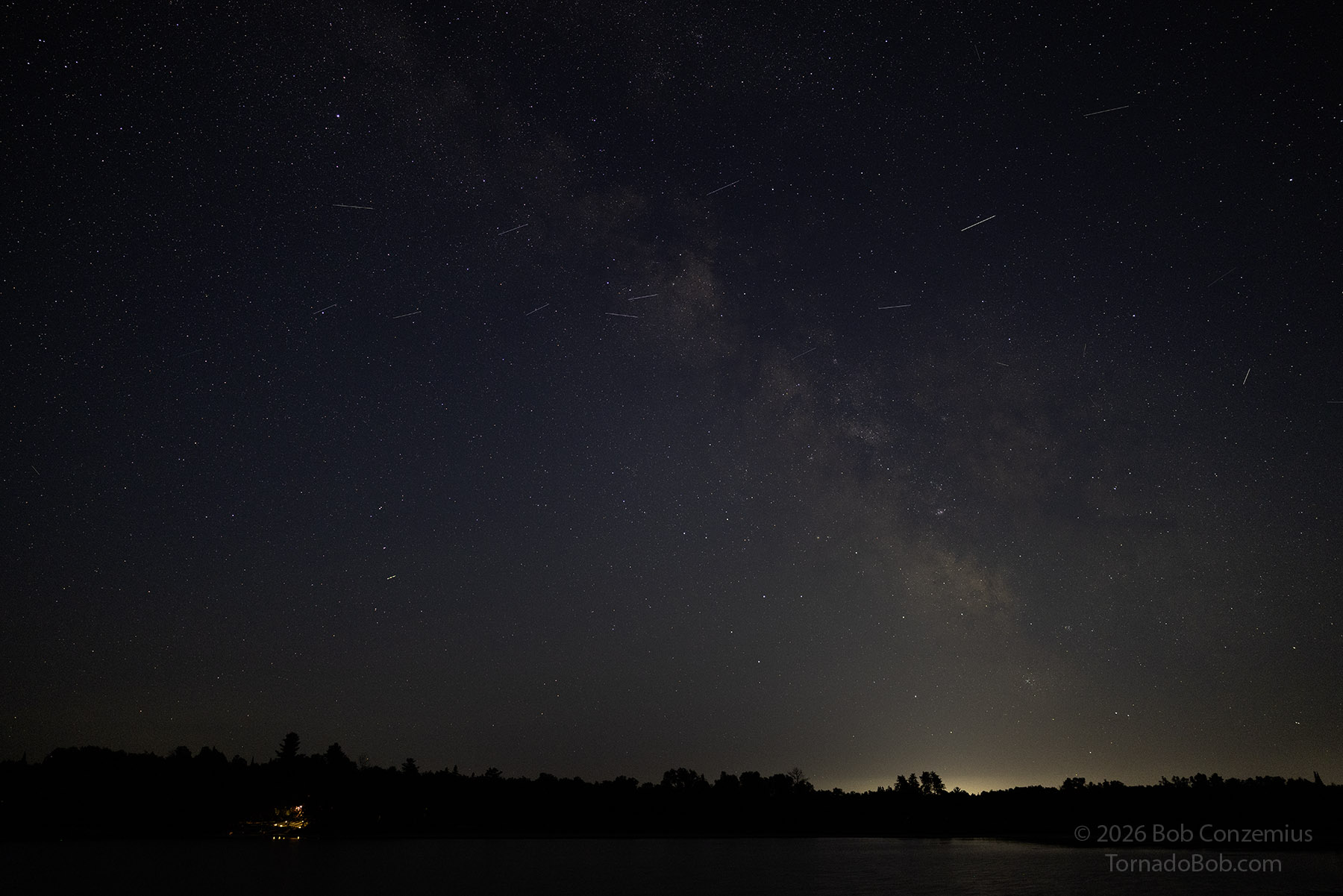
What was really astounding was the number of satellites in the sky now. I took a picture of the Milky Way, and there were literally swarms of them. I think this is the most I've ever seen aside from one of those Starlink satellite trains, which I don't seem to see anymore, so maybe SpaceX is releasing those somewhat differently now.